The hidden cost of remote MCPs


There's a lot of excitement around MCP right now. Connect your AI to Notion, Google Docs, Confluence — wherever your documents live — and it can pull in context on the fly. It sounds great in theory. In practice, remote MCPs come with a cost that most people aren't thinking about.
When an AI agent needs context from a remote MCP, the request path looks like this: the LLM talks to your local machine, which makes a request to the remote service's API, waits for a response, and sends it back to the LLM.
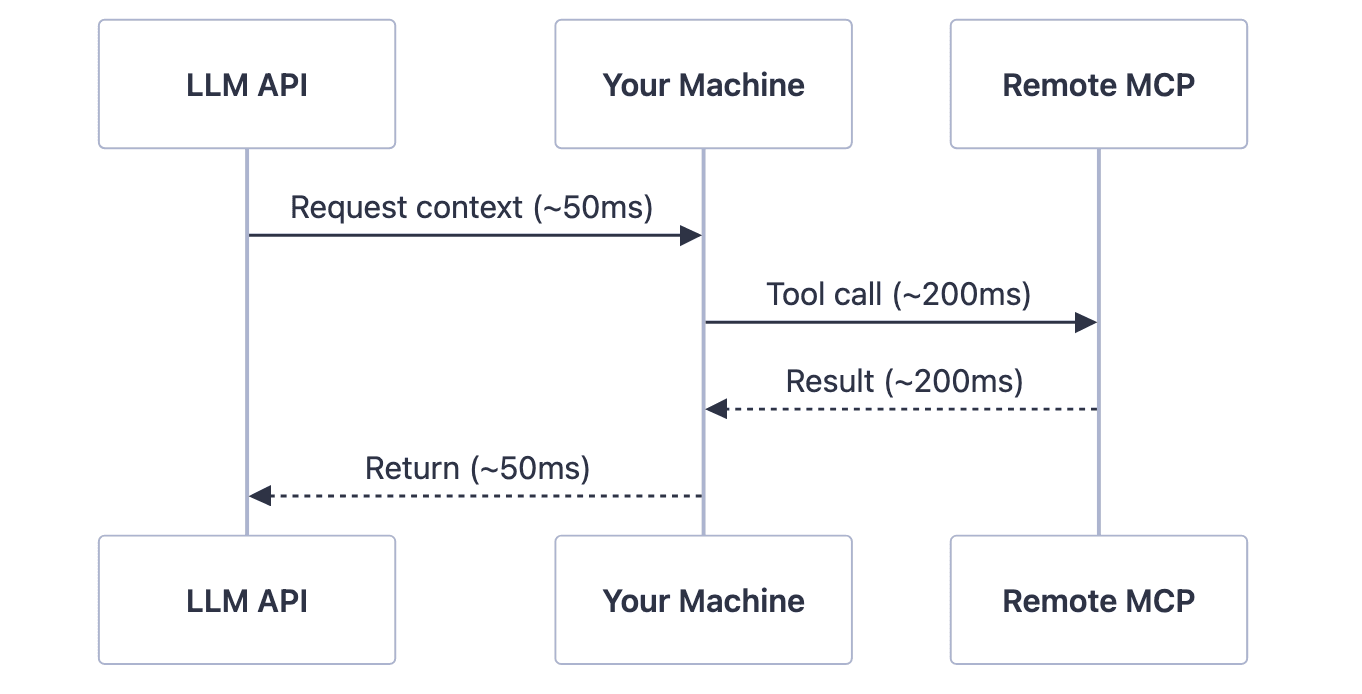
That's a minimum of two network hops for a single piece of information. If the agent needs to make multiple calls — and it usually does — each one has to round-trip through the full LLM inference cycle before the next can begin. ScaleKit found that MCP uses 4–32x more tokens than CLI equivalents for identical tasks, with a 72% reliability rate due to TCP timeouts.
MCP uses 4-32x more tokens than CLI equivalents for identical tasks
Compare that to reading a local file. A filesystem read takes less than a millisecond. No network hop, no API authentication, no tool schema overhead. The tooling AI agents use to read local files is incredibly mature — they can request all or part of a file, grab just the sections they need, and keep token usage minimal.
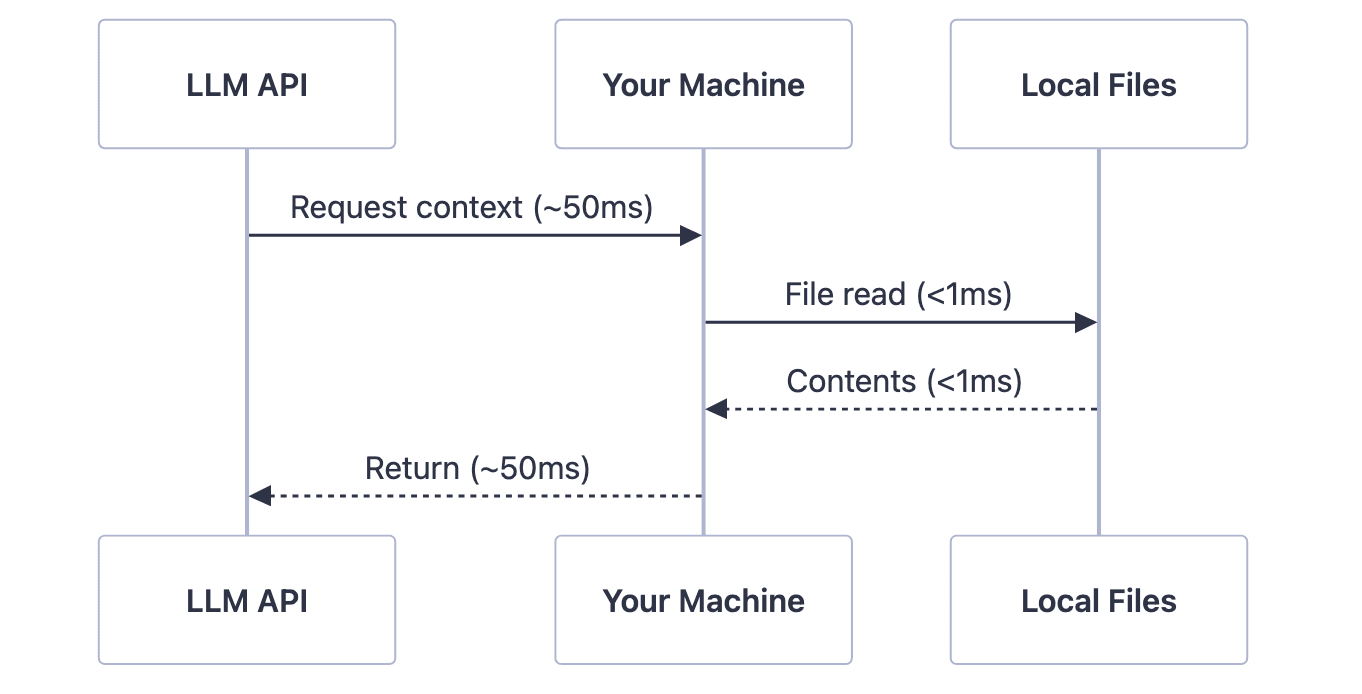
This is one of the reasons I built ContextStore as a local-first app. Your context repository — product vision, customer profiles, feature specs — lives on your machine as plain Markdown files synced to GitHub. When an agent reads your product vision, it's a filesystem read, not an API call chain. No round trips. No token tax. No timeouts.
Remote MCPs have their place. They're useful for actions — creating issues, sending messages, updating records. But for knowledge — the documents and context your AI needs to make good decisions — local files win on every axis. Faster, cheaper, more reliable. If you're building a context repository, keep it on your local file system.
Comments
You might also like…
Give your AI the full picture with a context repository
John LongAIPoor AI output usually isn't a prompting problem, it's a context problem. A context repository gives your AI the business knowledge it needs to make good decisions. Here's how to build one.

Introducing ContextStore: a native Mac app for context repositories
John LongContextStorePoor AI output is usually a context problem, not a prompting problem. ContextStore is a native Mac app that makes it easy for anyone on your team to build and manage a Markdown-based context repository.
Make your AGENTS.md a table of contents
John LongAIMost AGENTS.md files try to do too much. Treat yours as a table of contents — link to essential docs, let your LLM know where to look, and keep the file itself short and scannable.

If software becomes ephemeral
John LongAIWhen software can be conjured from a conversation, the real differentiator won't be the code — it'll be the taste, the brand, and the vision behind it.